

What the MCP server exposes
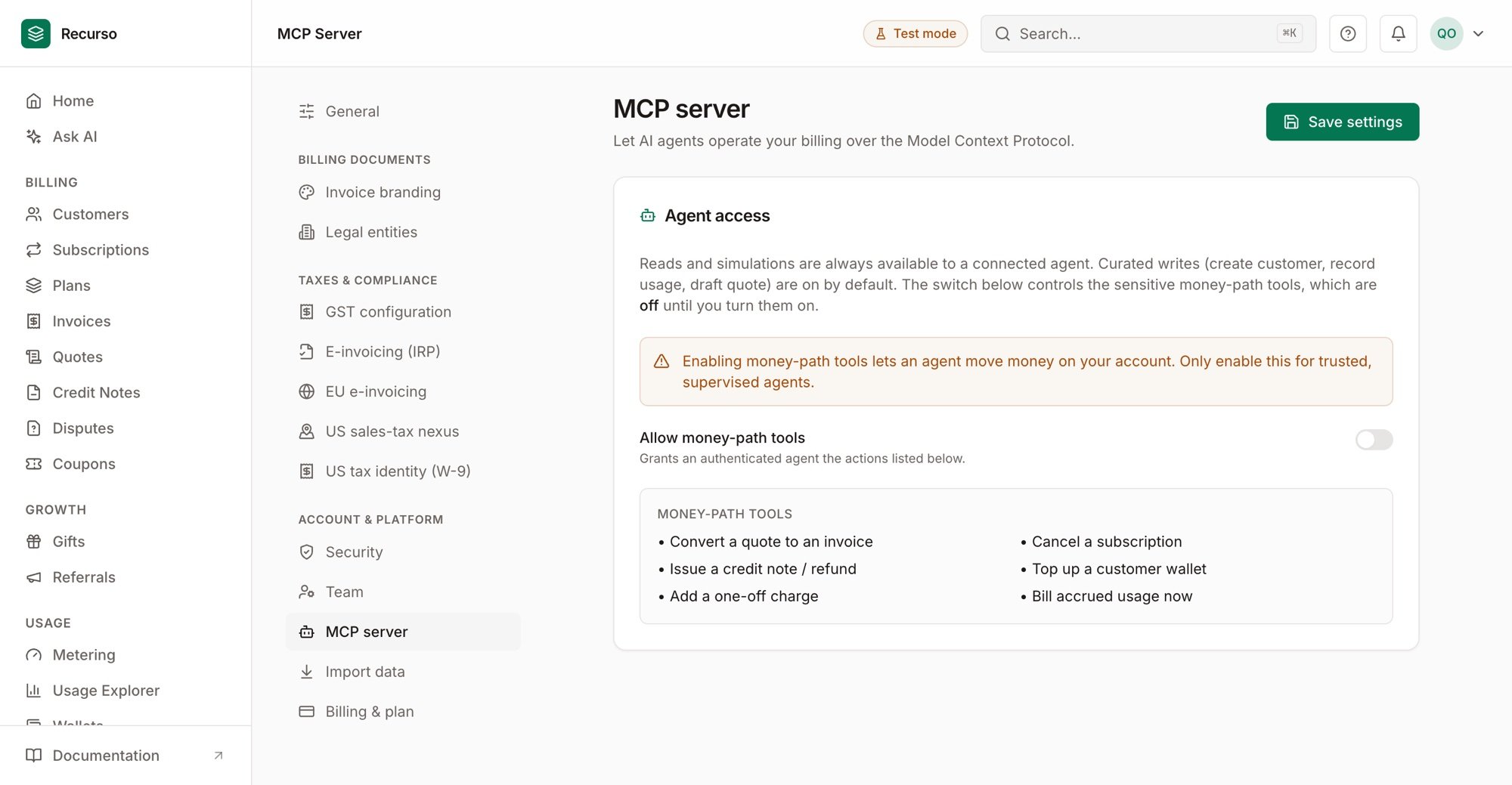
MCP server settings — money-path tools are off by default
Reads and simulations are always available. Curated writes are on by default.
Money-path actions (issuing invoices, refunds, cancellations) are off until
you opt in.
Tool tiers
Tools are grouped into three tiers by how much they can affect your account.Reads & simulations
Always on. List and fetch customers, subscriptions, invoices, plans, quotes,
and metrics; preview a plan change; simulate charges; inspect usage. No side
effects.
Curated writes
On by default, idempotent. Create and update customers, record usage
(single or batch), create and update subscriptions, draft and send quotes.
Retries can never double-apply.
Money-path
Off until you opt in. Convert a quote to an invoice, cancel a subscription,
issue a credit note, top up a wallet, add a charge, bill usage now.
Authentication
The MCP server never holds a credential of its own. The agent supplies your Recurso API key, and Recurso derives the tenant and live/test mode from it.- Remote (Streamable HTTP): send
Authorization: Bearer rsk_live_…with each request. Multi-tenant — each caller uses their own key. - Local (stdio): the key comes from the
RECURSO_API_KEYenvironment variable and is used for every call.
Connect an agent
Claude Desktop (local, stdio)
Add the server toclaude_desktop_config.json:
Remote client (Streamable HTTP)
Point any MCP-capable client at the hosted endpoint and pass your key:What an agent can do
A typical supervised session:You: What’s ACME’s MRR? Draft a renewal quote at a 10% discount and show me the invoice preview.The agent calls
list_customers and analytics reads to find ACME, create_quote
to draft the renewal, and get_invoice_preview to show the numbers — all without
issuing anything. If it then tries convert_quote_to_invoice while money-path
tools are disabled, the call is refused and reported back, so nothing is billed
without your say-so.
Enterprise controls
Money-path actions taken through an agent inherit the same governance as the dashboard:- Segregation of duties — refunds and credit notes follow a maker-checker flow: one role drafts, a separate admin or owner approves.
- Audit trail — every credit note records
created_by,approved_by, andapproved_at, reconciled on Recurso’s double-entry ledger. - Idempotency — every write carries an idempotency key, so a retried tool call is never applied twice. See Idempotency.
Related
Developer settings
Create and manage the API keys agents authenticate with.
Idempotency
How Recurso makes retried writes safe.